
The October 27, 2026, Israeli national election and the midterm elections that were held in the United States on November 3 have produced results that may open the door to major changes in both countries. The elections are also destined to have a significant impact on both the US and Israel’s foreign and security policies, and seem likely to have profound consequences on the geopolitics of the Middle East as a whole.
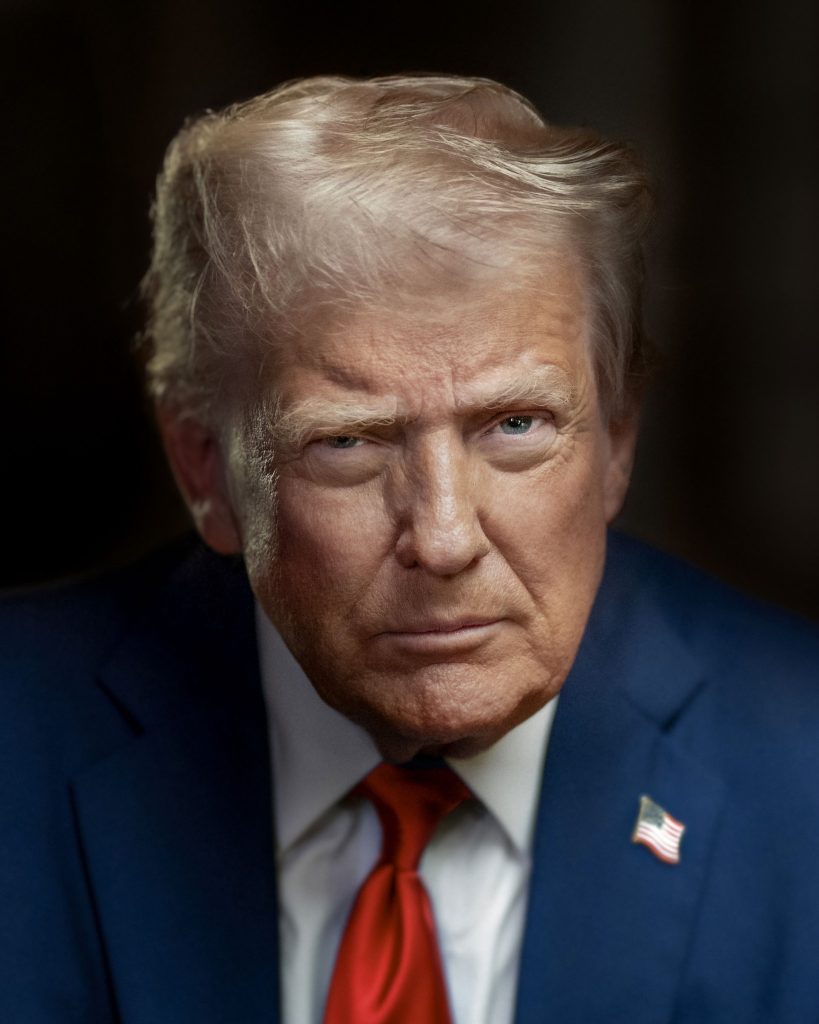
In many ways, both elections represented referendums on two leaders – Benjamin Netnayahu in Israel and Donald Trump in the United States. Netanyahu and Trump have profoundly shaped the domestic political, economic, and social landscape of their countries. Both leaders have articulated highly divisive and often controversial domestic political agendas. They have also played crucial roles in the geopolitical shifts and the conflicts that are shaking the Middle East – in particular the war in Gaza and the conflict with Iran.

A Tale of Two Elections
As already mentioned, the elections have been in significant part referendums on Netanyahu and Trump. The results of the elections can be considered a defeat for both leaders – especially for Trump in the United States. The uneasy partnership between Trump and Netanyahu has been crucial in shaping major foreign policy developments in the Middle East, such as the October 2025 ceasefire in Gaza and the decision – last February – to launch a war against Iran. Both in Israel and in the United States, however, the strongest factors shaping voters’ decisions appear to have been domestic concerns – especially economic considerations.
The National Election in Israel
Israel’s election was very contested. The country has a single house of parliament known as the Knesset. The 120 members of the Knesset are elected in a single nationwide electoral district and serve for four years. Israel has a proportional electoral law with closed lists. In order to be represented in parliament, parties or party alliances must obtain at least 3.25% of the vote. The 2026 campaign was extremely tense and the very high turnout – the highest since 1999 – demonstrated that Israeli voters perceived it as a crucial political turning point for the country.
The main concerns shaping the orientation of Israel’s voters revolved around national security, the rising cost of living, and the status of the country’s Ultra-Orthodox Jews – particularly their longstanding but increasingly unpopular exemption from military service. Before the October 7, 2023 terrorist attacks perpetrated by Hamas against Israel, the most contentious political issue in the country was a controversial judicial reform. This issue was partially superseded by October 7 and the vortex of conflict associated with Israel’s response to the Hamas attacks. Last month, however, many voters went to the polls convinced that the future of Israel’s democracy was at stake. The election was in many ways also a vote on Benjamin Netanyahu and his legacy. The Likud leader – also known as “Bibi” – stands out as a very skilled politician and an exceptional political survivor, and is the longest-serving Prime Minister in the history of the country. Netanyahu, however, is also widely known as an extremely controversial politician. As these lines are written, Netanyahu has received an arrest warrant from the International Criminal Court for alleged war crimes and crimes against humanity committed in the context of the war in Gaza and is facing trials at home in Israel for corruption. Netanyahu has also repeatedly blocked attempts to conduct an official investigation on the causes of the failure to prevent the October 7 terrorist attacks.
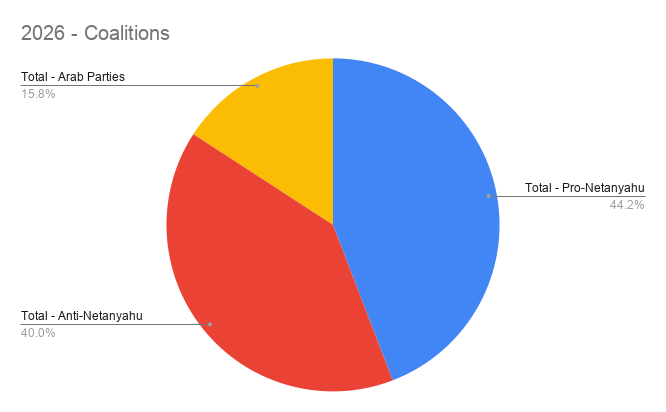
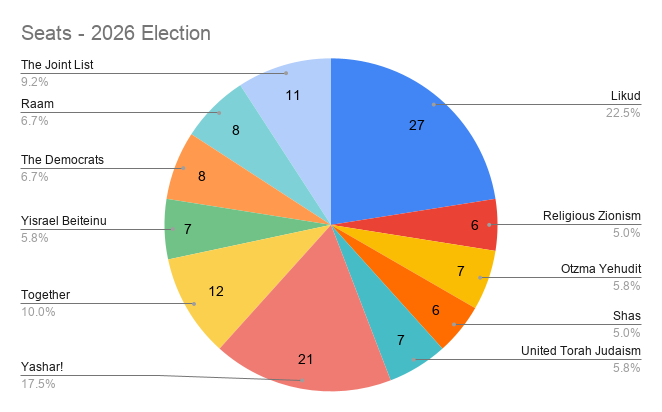
The results of the election represent a defeat for Netanyahu but have failed to produce a clear path to a new government. Even though the Likud remains the largest party in the Knesset, Netanyahu’s far-right coalition has obtained only 53 seats – well below the 61-seat threshold required to form a government. The anti-Netanyahu camp, however, is quite fragmented. Among the forces that ran against Netanyahu, a coalition of Jewish parties ranging from the right to the left of the political spectrum has obtained 48 seats. Within this camp, the left-wing Democrats obtained 8 seats – doubling their 2022 score. The centrist and conservative opposition to Netanyahu, on the other hand, came short of expectations, although with 21 seats, Yashar – a new party created in 2025 around Gadi Eisenkot, a retired IDF general who served as Chief of Staff of Israel’s military – is second only to Netanyahu’s Likud (27 seats). A third bloc – Israel’s Arab parties – faced a very difficult campaign. In September, the country’s Central Elections Committee banned the Arab parties from running in the election but the Supreme Court overturned that decision and allowed them to compete. In the event, the Arab parties performed surprisingly well and obtained a total of 19 seats – with the Joint List more than doubling its number of parliamentary seats.
The US Midterm Elections
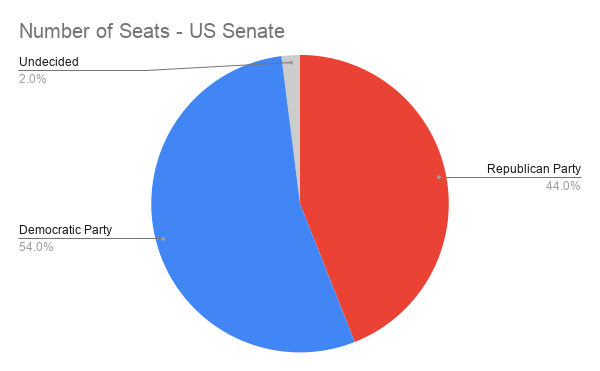
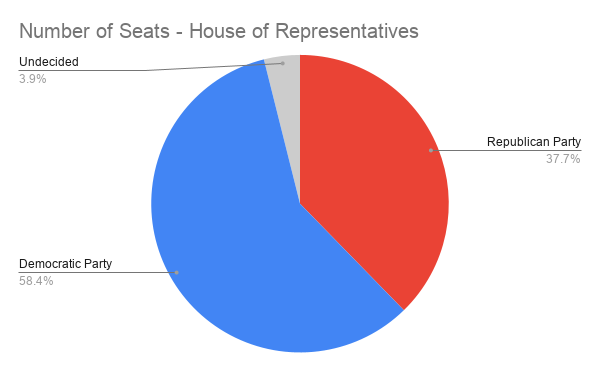
The midterm elections of November 3 were a debacle for Trump and the Republican Party. The 2024 election cycle had given the “Grand Old Party” slight majorities in both houses of Congress – 53 seats out of 100 in the Senate and 220 seats out of 435 in the House of Representatives. The 2026 midterm elections have completely reversed the balance of power between Republicans and Democrats in Congress. On November 3, one third of the Senate and the entire House were up for reelection, and in both cases seats were awarded on a first-past-the-post basis. As these lines are written, the Democrats have a 54-seat majority in the Senate and a 254-seat majority in the House. The swing to the left was particularly strong among young voters, but it seems that every demographic group in the US moved towards the Democrats. Progressive and democratic socialist candidates also made significant gains within the Democratic camp.
Opinion polls indicate that the most important issue in the mind of American voters on the eve of the election was inflation and the rising cost of living. An additional crucial concern was an increasing perception that corruption was growing in the country and that elected officials cared more about their own and their donors’ interests than the public good. The war in Iran was not among the most pressing concerns of American voters. However, the conflict is unpopular and did severely impact the cost of living in the US because of its massive repercussions on the price of gas, which has seen a steep increase across the country – and around the world. In a long post on X, Vice President JD Vance argued that the key factor determining the November 3 debacle was the Iran War. Vance also added that American voters wanted a redefinition of the relationship between the United States and Israel. It is interesting to note that on October 18 – barely ten days before the Israeli election – Donald Trump endorsed Netanyahu while Vance declined to do so.
Regime Change? The Path Forward in Israel and the United States
The results of the elections have been negative for both Netanyahu and Trump – particularly for the US president. These developments open the possibility for major changes in both countries. But the marked differences between the Israeli and the American political system create a very wide range of scenarios.
The Israeli Jigsaw
In Israel, the fragmented political landscape may converge towards a new government coalition that excludes Netanyahu and his far-right political allies. On November 8, Israel’s President Isaac Herzog concluded that Eisenkot had the best chances of forming a new government and gave the leader of Yashar the opportunity to assemble a new governing coalition. Eisenkot has up to six weeks and several options to try to achieve this task:
- He may work to unite the Jewish anti-Netanyahu coalition and the Arab parties. Such an option would give his government a comfortable 67-seat majority. Even though the leaders of the Arab parties have indicated Eisenkot as their preference for the post of Prime Minister, several obstacles – such as the aversion to such an alliance manifested by some of the leaders of the anti-Netanyahu camp during the election campaign – make the task of assembling such an heterogeneous government coalition quite difficult. Alternatively, Eisenkot could form a minority government with the external backing of the Arab parties, but such an arrangement might be unstable and short lived.
- Eisenkot could also try to poach the Ultra-Orthodox parties that ran with Netanyahu and achieve a 61-seat majority. In this case, however, the margin would be very thin and the new government would probably have to accept the continuation of the exception from military service for the Ultra-Orthodox Jews – an increasingly unpopular issue in a country where in the last three years hundreds of thousands of citizens have been called to serve in the military as reservists.
- Finally, Eisenkot could also form a “unity government” with Netanyahu. In this case, however, the anti-Netanyahu coalition would betray its most important electoral pledge. Moreover, in such a coalition, Netanyahu would be by far the most shrewd and skilled political player, and it is reasonable to expect that the Likud leader would use his skills to outsmart the rest of his coalition partners.

Divided Government in the United States
In the US, starting in January 2027 and until the end of his mandate in 2028, Trump will face a situation of “divided government” with Congress dominated by the Democrats. Both the Republicans and the Democrats, however, appear to be in the process of redefining their core values and their policy agendas. The defeat in the midterms has profoundly shaken the Republican Party. Since 2016, Trump had managed to unify the different souls of the GOP around himself. The November 3 debacle, however, is bringing back to the surface the divide between die-hard Trump loyalists and the rest of the party establishment. As demonstrated by Vance’s comments, divisions are increasing within the White House as well. Key foreign policy decision-makers – like the Vice President and Foreign Secretary Marco Rubio – are distancing themselves from unpopular policies like the Iran War. Bipartisan consensus is rising to call for the resignation or the impeachment of Defense Secretary Pete Hegseth. In fact, the resolution to start the impeachment procedure against Hegseth was introduced in the House by Representative Thomas Massie of Kentucky – a Republican. On the other hand, Trump’s decision to appoint Stephen Miller as his new Chief of Staff may indicate that the president is not inclined to compromise with dissenters within his own party. With members of the administration like Vance and Rubio distancing themselves from Trump’s signature policies and considering leaving the administration in order to prepare their bids to be the Republican frontrunner in the 2028 presidential election, turnover might leave Trump increasingly surrounded by loyalists and reinforce some of his stances. At the same time, the new Democratic majorities that are taking office in the House and the Senate in January 2027 must find a way to bring consistency to a party where centrists and progressives show significant differences in the realm of both domestic and foreign policy.

The Implications of the Elections for the Middle East
The most pressing geopolitical challenge associated with the Middle East on the desk of President Trump is the conflict with Iran. Operation Epic Fury – also known in Israel as Operation Roaring Lion – failed to overthrow the Iranian regime or eliminate the threat of a nuclear armed Iran. At the same time, Iran has demonstrated an ability to retaliate asymmetrically against US and Israeli military attacks by hitting the Persian Gulf states and other US allies in the region as well as by closing the Strait of Hormuz. The United States and Iran reached a tentative ceasefire last April and signed a Memorandum of Understanding in June. However, the conflict has in fact been dragging on with an American counter-blockade and other forms of military and economic pressure on the part of the US that so far have failed to persuade Iranian leaders to reopen the strait. As already mentioned, the the stalemate in the Gulf is pushing up prices on global energy markets, with negative consequences for the entire global economy.

The Trump administration has been exploring the possible resumption of major military action against Iran. The most aggressive military option would be a new, sustained air campaign against Iran’s infrastructure and energy network, military assets, and nuclear sites. Trump and his advisers have also discussed the option of a shorter and more limited campaign that would exclude energy and infrastructure and only focus on military and nuclear targets. The Trump administration appears particularly determined to target an underground nuclear site known as “Pickaxe Mountain.” Such a target could be hit using a massive ordnance air blast bomb – also known as a MOAB – or a massive ordnance penetrator – aka a MOP. The problem with a resumption of major hostilities is that the Tehran regime has already proven that it can absorb massive damage and still retaliate with an “horizontal escalation” on the Hormuz chokepoint and against US allies and military assets in the region. As evidenced by Vance’s comments, moreover, the war against Iran is indeed very unpopular in the US, and opinion polls indicate that a significant majority of Americans feel that the war has not been worth fighting. Another option for the Trump administration would be the continuation of the current low-intensity military confrontation in the Strait of Hormuz, hoping that eventually the situation remains manageable or that negotiations – either direct talks or negotiations between Iran and its Persian Gulf neighbors – lead to an off-ramp. The US and Israeli electoral cycles have further complicated the picture. The Iran War and the prospect of regime change in Tehran have been quite popular in Israel. It appears that Netanyahu pushed for a new attack against Iran before the Israeli election, although the country’s military leaders resisted such an initiative.
The results of the midterms will test the relationship between the United States and Israel in relation to the situation in Gaza as well. In the fall of 2025, Trump’s pressure was crucial in the achievement of a ceasefire and the approval of a 20-point “Comprehensive Plan to End the Gaza Conflict.” The ceasefire, however, was repeatedly violated by both Hamas and Israel, and as a result it is estimated that 1,300 Palestinians have lost their lives in Gaza since October 2025. The war in Iran, moreover, has prevented progress on the implementation of Trump’s plan. As reported by Axios, after the midterms Trump informed Netanyahu that he wanted to resume the implementation of the “Comprehensive Plan.” On the other hand, it is important to note that surveys indicate that the October 7 attacks are still a major influence on Israel’s Jewish voters, and that both the pro- and the anti-Netanyahu coalitions expressed hawkish and uncompromising attitudes regarding the crisis in Gaza and Israel’s national security. Eisenkot has lost one son and two nephews in the Gaza War and has vowed to end Hamas’s rule in the Strip. Hence, in the foreseeable future, progress on the Israeli-Palestinian peace process appears unlikely, and it seems reasonable to expect any new Israeli government to resist pressure to relinquish the territory that Israel now controls in Gaza – as well as in southern Lebanon and Syria. On the other hand, it is clear that a majority of Americans – across the political spectrum – are unsatisfied with the current state of the US relationship with Israel. A slight majority of Americans also thinks that US military support for Israel should be decreased or discontinued. This trend is beginning to influence the outlook of both the Republicans and the Democrats.

On the eve of the midterm election, Trump announced that by the end of the year his administration would indeed discontinue a significant part of the US military assistance to Israel – which amounts to around $4 billion a year. This announcement might have been dictated in part by political expediency and the president did not mention plans to favor a much stronger integration between the American and Israeli military and intelligence apparatuses. However, Trump’s announcement may also indicate the acknowledgement of an increasing bipartisan consensus on the urgent need to redefine the US-Israeli relationship. In this respect, a new Israeli government without Netanyahu and his far-right allies could perhaps represent an opportunity to favor the rise of a different US-Israeli partnership and the emergence of a new Middle Eastern order. A government coalition including Israel’s Arab parties would represent a powerful rejection of the ethno-nationalist and far-right outlook that has been pursued by the Netanyahu government – the most right-wing government in the history of Israel. The US could incentivize a redefinition of Israel’s domestic and national security policy by supporting such an inclusive government and making US military and political support for Israel conditional on the abandonment of the judicial reform, the end of tolerance for settler violence against the Palestinians in the West Bank, and progress in the implementation of the Comprehensive Plan for Gaza. The path towards a just and sustainable resolution of the Israel-Palestine question would remain very long, but progress on these issues could give rise to new hope and build momentum.
The Elusive Search for a New Equilibrium
The shifting political landscape examined in these pages is likely to have profound implications for the Middle East, but any analysis of the likely short- and long-term consequences of the US and Israeli elections paints a rather uncertain picture. The militaristic policies followed by Netanyahu and Trump might give way to greater political pragmatism and a new effort to end conflicts and promote regional stability. In the short term, however, the difficult quest for a new political equilibrium could lead to more volatility in both Israel and America’s foreign policy.
Diego Pagliarulo